
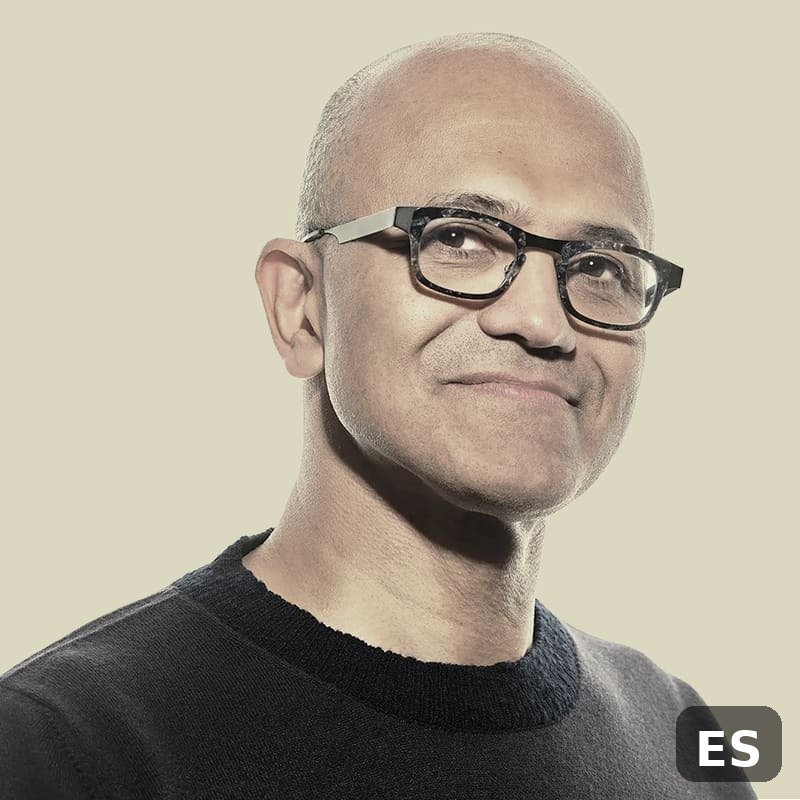
Satya Nadella and Michel Vounatsos are two chief executives who defined an era in their industries — and ended up with fortunes as different as their legacies. Nadella turned Microsoft into a cloud and AI powerhouse and became a billionaire in the process. Vounatsos bet Biogen’s future on an Alzheimer’s drug, weathered one of the most controversial launches in pharma history, and left with a respectable $32 million.
Both men climbed to the top job through decades of operating experience rather than founding companies. Nadella joined Microsoft in 1992 and spent 22 years inside the company before becoming its third CEO. Vounatsos spent two decades at Merck, mastering commercial operations across Europe, the United States and China, before taking over Biogen in 2017.
This article compares the net worth of both executives, traces the career milestones that built their wealth, and examines why one CEO’s defining bet paid off spectacularly while the other’s became a cautionary tale. There is much more to the story than the dollar figures.
Quick Bio: Satya Nadella
| Detail | Fact |
|---|---|
| Full Name | Satya Narayana Nadella |
| Known For | Chairman and CEO of Microsoft |
| Born | August 19, 1967, Hyderabad, India |
| Nationality | Indian-American |
| Profession | Technology executive |
| Education | Manipal Institute of Technology (B.Tech, 1988); University of Wisconsin–Milwaukee (M.S., 1990); University of Chicago Booth (MBA, 1997) |
| Spouse | Anupama (Anu) Nadella |
| Children | 3 |
| Current Status | Active — Chairman and CEO of Microsoft |
Quick Bio: Michel Vounatsos
| Detail | Fact |
|---|---|
| Full Name | Michel Vounatsos |
| Known For | Former CEO of Biogen |
| Age | Early 60s (born in the early 1960s; exact date not publicly disclosed) |
| Nationality | Not publicly confirmed (raised in Morocco, educated in France) |
| Profession | Pharmaceutical executive |
| Education | Educated in France (specific institutions not publicly disclosed) |
| Spouse | Married (wife is a doctor; name kept private) |
| Children | 3 |
| Current Status | Former CEO — left Biogen at the end of 2022 |
Who Is Satya Nadella?
Satya Nadella is the chairman and chief executive officer of Microsoft, the third person to hold the CEO title in the company’s history after Bill Gates and Steve Ballmer. Since taking over in February 2014, he has transformed Microsoft from a software company clinging to its Windows past into a cloud computing and artificial intelligence leader worth trillions of dollars.
Before becoming CEO, Nadella led Microsoft’s Cloud and Enterprise group, where he was the architect of the company’s pivot to cloud infrastructure — the Azure business that now anchors Microsoft’s growth. He joined Microsoft in 1992 after a brief stint at Sun Microsystems, and spent 22 years rising through the company’s engineering and business ranks.
His tenure as CEO is defined by landmark acquisitions: LinkedIn for $26.2 billion in 2016, GitHub for $7.5 billion in 2018, the $69 billion purchase of Activision Blizzard in 2023, and a multibillion-dollar partnership with OpenAI that positioned Microsoft at the center of the AI revolution. He also wrote the memoir Hit Refresh in 2017, laying out his philosophy of empathetic, growth-mindset leadership.
Who Is Michel Vounatsos?
Michel Vounatsos is the former chief executive officer of Biogen, the Cambridge, Massachusetts-based biotechnology giant. He led the company from January 2017 until December 2022, a tenure dominated by the rise and fall of Aduhelm (aducanumab), Biogen’s controversial Alzheimer’s drug.
Vounatsos joined Biogen in April 2016 as executive vice president and chief commercial officer after a two-decade career at Merck & Co., where he held leadership responsibilities across the company’s Europe, United States and China divisions. Raised in Morocco and educated in France, he speaks six languages — a reflection of a career spent operating across global markets.
His time as CEO coincided with Biogen’s most turbulent period. The company won accelerated FDA approval for Aduhelm in June 2021, but the launch collapsed amid controversy over the drug’s efficacy, its $56,000 annual price tag, and Medicare’s subsequent refusal to broadly cover it. In May 2022, Biogen announced Vounatsos would step down; he remained through the end of the year to assist the transition to his successor, former Sanofi chief Chris Viehbacher.
Nadella’s Rise: From Hyderabad to Microsoft’s Corner Office
Nadella’s journey began in Hyderabad, India, where he attended the prestigious Hyderabad Public School, Begumpet. He earned his bachelor’s degree in electrical engineering from the Manipal Institute of Technology in 1988, then moved to the United States for a master’s in computer science from the University of Wisconsin–Milwaukee in 1990. While working full-time at Microsoft, he completed an MBA at the University of Chicago Booth School of Business in 1997.
His early career at Microsoft was in enterprise software — the unglamorous but lucrative business of selling servers and tools to corporations. As head of the Server and Tools division and later the Cloud and Enterprise group, he bet the company’s future on cloud computing at a time when many inside Microsoft still saw Windows as the crown jewel. That bet became Azure, now one of the two dominant cloud platforms in the world alongside Amazon Web Services.
When the Microsoft board chose him as CEO in February 2014, the company was widely seen as stagnating. Nadella’s response was cultural as much as strategic: he replaced Ballmer’s combative internal culture with a “learn-it-all” growth mindset, opened Microsoft to open-source software and rival platforms, and redirected capital toward cloud and AI. Microsoft’s market value has multiplied many times over since, and its stock rose nearly 23 percent in 2025 alone.
Vounatsos’s Journey: Two Decades at Merck to Biogen’s Top Job
Vounatsos built his reputation the old-fashioned way: twenty years at Merck, one of the world’s largest pharmaceutical companies, running commercial operations across three continents. His experience leading Merck’s Europe, U.S. and China divisions gave him a rare global commercial perspective in an industry where most CEOs rise through research and development.
Biogen recruited him in 2016 as chief commercial officer, and within a year he was CEO, succeeding George Scangos. His first full year at the top earned him $13.6 million in total compensation — a base salary of $1.08 million plus $9.86 million in equity awards — as he set out to defend Biogen’s multiple sclerosis franchise against generic competition and pricing pressure.
The defining gamble of his tenure was Alzheimer’s. Biogen poured its future into aducanumab, and when the FDA granted accelerated approval in June 2021, it looked like a historic victory. But physicians balked at the thin clinical evidence, the price provoked outrage, and Medicare’s decision to severely restrict coverage effectively killed the launch. The board cut Vounatsos’s 2021 bonus in half to hold him accountable for business performance. By the time he departed, Biogen’s revenue had fallen from a 2019 peak of $14.4 billion to $10.2 billion, and the company was searching for a new direction under Viehbacher — who quickly moved the company past Aduhelm and toward Leqembi, its next Alzheimer’s treatment developed with Eisai.
Net Worth Breakdown: Nadella’s $1.1 Billion Fortune
Satya Nadella’s net worth is estimated at approximately $1.1 billion, according to Forbes and Bloomberg assessments from late 2025, making him one of the few non-founder CEOs to reach billionaire status. Some analyses place the figure as high as $1.3 to $1.5 billion when unvested stock awards are included; others, counting only disclosed holdings, come in lower. The consensus for 2026 sits firmly in the billion-dollar range.
His wealth is almost entirely a product of Microsoft equity. For fiscal 2025, Nadella earned $96.5 million in total compensation — up 22 percent from $79.1 million the prior year — on a base salary of just $2.5 million, with the rest coming from stock awards and a $9.5 million cash bonus. He owns roughly 0.01 percent of Microsoft’s stock, a small slice of an enormous pie that has compounded relentlessly during his twelve years as CEO.
Unlike founders such as Gates or Ballmer, Nadella arrived at the top with no significant equity stake; every dollar of his fortune was earned through performance-linked compensation. It is perhaps the purest example in corporate America of the modern CEO wealth machine: take over a great company, multiply its value several times over, and let equity awards do the rest.
Net Worth Breakdown: Vounatsos’s $32 Million Fortune
Michel Vounatsos’s net worth is estimated at just over $32 million, based on Wallmine’s analysis of his Biogen holdings and compensation — a substantial fortune, but roughly three percent of Nadella’s. His wealth came from six years of biotech CEO pay plus two decades of Merck earnings before that.
The numbers trace his arc at Biogen precisely. He earned $18.66 million in 2020 and more than $15 million in 2021 despite the bonus cut. His final year, 2022, brought his biggest payday: $26.6 million in total compensation, including nearly $8.8 million in severance pay as part of his departure agreement. Combined with incoming CEO Chris Viehbacher’s $30.5 million package, Biogen paid its two CEOs more than $57 million in a single year.
Vounatsos also accumulated Biogen stock through annual equity awards; early in his tenure he held more than 18,900 shares. Since leaving Biogen at the end of 2022, he has kept a low public profile, and his current business activities have not been widely publicized. His fortune reflects a successful but ultimately unfulfilled CEO tenure — well compensated, but without the equity compounding that turns a good CEO into a billionaire.
Nadella vs. Vounatsos: Contrasting CEO Legacies
The two men faced eerily similar strategic choices — each bet his company’s future on a single transformative wager — and got opposite results. Nadella bet Microsoft on cloud computing and then on artificial intelligence; both bets paid off beyond anyone’s imagination. Vounatsos bet Biogen on Alzheimer’s disease; the science, the regulators and the payers all pushed back.
Their leadership styles differed just as sharply. Nadella is famous for empathy and cultural transformation, writing openly about how raising a son with special needs shaped his worldview. Vounatsos was a commercial operator in a science-driven company, and his tenure was marked by tension with Biogen’s research establishment — including the departure of longtime chief scientist Al Sandrock amid a reported dispute.
There is also a lesson in the math of CEO wealth. Nadella’s fortune grew because Microsoft’s stock compounded for over a decade under his leadership; every equity grant multiplied. Vounatsos’s Biogen stock, by contrast, slid as revenue declined each year from 2019 to 2022. In the modern executive economy, a CEO’s net worth is essentially a leveraged bet on the company’s share price — and the share price is the market’s verdict on the CEO’s strategy.
What Most Net Worth Profiles Get Wrong
Satya Nadella’s net worth is one of the most inconsistently reported figures in business media. Depending on the source, you will find estimates ranging from $350 million to over $2 billion. The low-end figures typically count only his disclosed Microsoft shareholdings and ignore unvested awards; the high-end figures pile on speculative real estate and investment values. The credible anchor remains Forbes and Bloomberg at approximately $1.1 billion in late 2025 — treat anything far outside the $1 billion to $1.5 billion range with skepticism.
For Vounatsos, the common error is outdated job titles. Many thin profiles still list him as Biogen’s CEO. He is not: he announced his departure in May 2022, stayed through December 2022, and was succeeded by Chris Viehbacher, who took over in November 2022. Any profile describing Vounatsos as the current Biogen chief is more than three years out of date.
Finally, some AI-generated articles about Nadella drift into bizarre territory — one even discusses corporate Bitcoin treasuries and “tokenmaxxing” in the same breath as his net worth. Readers should stick to established financial publications for compensation and wealth figures, and treat sensational outliers as what they are.
Bottom Line
Satya Nadella and Michel Vounatsos prove that the CEO title alone does not make a fortune — the strategy does. Nadella inherited a stagnating software giant, bet it all on the cloud, and rode twelve years of compounding equity to billionaire status. Vounatsos inherited a proud biotech company, bet it all on curing Alzheimer’s, and left with a comfortable $32 million and a cautionary tale.
Their stories are a reminder that executive wealth is never really about salary. It is about being right, at scale, for a long time. Nadella was right about where technology was going, and Microsoft’s shareholders — and his own bank account — are the proof. Vounatsos took on one of medicine’s hardest problems and lost; his compensation reflects the attempt, not the outcome.
For more stories of business leaders whose careers shaped their fortunes, explore Essence Magazine.
Frequently Asked Questions
What is Satya Nadella’s net worth in 2026?
Satya Nadella’s net worth is estimated at approximately $1.1 billion, according to Forbes and Bloomberg assessments from late 2025. His wealth comes almost entirely from Microsoft stock awards accumulated during his tenure as CEO since 2014, plus annual compensation that reached $96.5 million in fiscal 2025.
What is Michel Vounatsos’s net worth in 2026?
Michel Vounatsos’s net worth is estimated at just over $32 million, based on his Biogen stock holdings and executive compensation. His final year at Biogen (2022) was his highest-paid at $26.6 million, including nearly $8.8 million in severance.
Is Michel Vounatsos still the CEO of Biogen?
No. Vounatsos announced he was stepping down in May 2022 and left the company at the end of that year. He was succeeded by Chris Viehbacher, the former Sanofi CEO, who took over in November 2022.
Why did Michel Vounatsos leave Biogen?
Vounatsos departed after the troubled launch of Aduhelm, Biogen’s Alzheimer’s drug. Despite winning accelerated FDA approval in June 2021, the drug faced backlash over its efficacy evidence and $56,000 annual price, and Medicare’s refusal to broadly cover it effectively ended the launch. The board had already cut his 2021 bonus in half over business performance.
How did Satya Nadella become Microsoft’s CEO?
Nadella joined Microsoft in 1992 and spent 22 years at the company, most notably leading the Cloud and Enterprise group that built the Azure cloud business. The board named him CEO in February 2014, succeeding Steve Ballmer, and he became chairman in 2021. Before Microsoft, he worked briefly at Sun Microsystems.
Are Satya Nadella and Michel Vounatsos connected?
No. Nadella and Vounatsos have never worked together; they led companies in entirely different industries — technology and biotechnology. They are compared here because both reached the CEO’s office of major public companies through long operating careers, and their contrasting tenures offer a striking study in how strategy shapes a CEO’s fortune.
